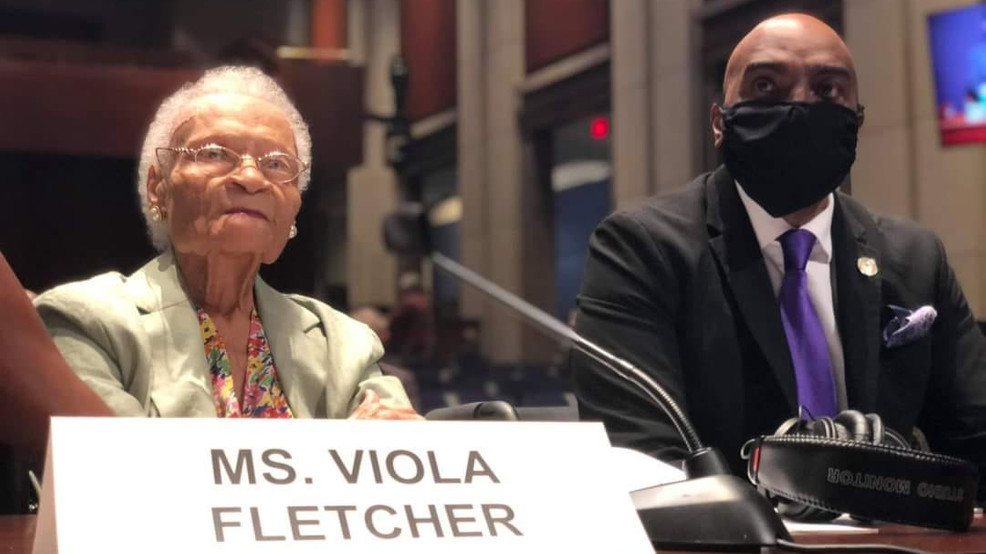
Viola Fletcher’s life is a luminous testament to human resilience, courage, and hope; a shining example of how the human spirit can endure even the darkest storms. Born in the Greenwood District of Tulsa, Oklahoma, Fletcher was only seven years old when the Tulsa Race Massacre of 1921 violently engulfed her community. Greenwood, celebrated as “Black Wall Street,” had thrived as a center of African American entrepreneurship, culture, and ambition. Within a few devastating hours, that vibrant community was razed to the ground. Homes and businesses were lost, families were torn apart, and countless lives were irreversibly altered.
The massacre was not merely a destruction of property but an assault on the dignity and dreams of an entire community. For young Viola, it was a moment of witnessing profound terror, confusion, and loss. Yet, in the face of such adversity, she displayed a resilience that would define her life. She endured the trauma with a strength that transcended mere survival—an inner fortitude shaped by faith, hope, and the support of her family and society.
Viola Fletcher’s story is remarkable not only for her survival but for the life she built in its aftermath. She lived through the eras of segregation, the Great Depression, the civil rights movement, and beyond, each period marked by societal inequities and challenges. Through it all, she maintained dignity, cultivated wisdom, and remained a steadfast witness to history. Her longevity has allowed her to bear testimony to a chapter of America’s past that is often overshadowed, ensuring that the voices of those silenced are heard through hers.
A defining moment in her later years came in 2021, when she testified before the United States Congress. Speaking with clarity, courage, and poise, she recounted the impact the massacre had on her life. She reminded lawmakers that although she survived physically, the destruction of her community shaped her opportunities and her family’s future for decades. Her message to Congress was not one of bitterness, but of truth; an appeal for justice, recognition, and the long-overdue acknowledgment of a national tragedy. Her testimony became a powerful national reminder that history lives not in books alone, but in the lives of those who endured it.
Her life is a profound reminder of the enduring consequences of racism and the necessity of confronting injustice wherever it persists. By speaking publicly about her experiences—including before Congress—Fletcher has become both historian and moral guide, illuminating the stark realities of racial violence while offering hope and inspiration. She reminds us that history is not only a record of events but a call to conscience, compelling future generations to recognize injustice and act against it.
The story of Viola Fletcher is inseparable from the broader narrative of Greenwood and its people. The massacre attempted to erase their achievements, but it could not extinguish their spirit. Fletcher’s life exemplifies the courage required to rebuild not only homes and businesses but also the hope and dignity of an entire community. Her journey demonstrates that survival is not merely an act of living but of reclaiming identity, pride, and purpose in the aftermath of violence.
Fletcher’s advocacy for justice underscores the long-term impact of racial violence on communities and families. Alongside other survivors, she has tirelessly championed recognition, reparations, and reconciliation. Her voice, imbued with the authority of lived experience, challenges society to confront the injustices of the past honestly. In doing so, she ensures that lessons are learned, memories are honored, and history does not repeat itself.
Beyond her role as a witness, Viola Fletcher’s life is a celebration of resilience and triumph. Her story teaches that the human spirit can endure immense suffering without surrendering hope. Through decades of personal and communal struggle, she has exemplified the strength, wisdom, and fortitude that emerge when courage is paired with faith and determination. Her life is a living testament to the power of perseverance and the beauty of reclaiming joy and purpose after tragedy.
Fletcher’s experiences also serve as an educational bridge for younger generations. By sharing her memories, she imparts historical awareness, moral insight, and a sense of responsibility. She reminds us that the evils of racism are not distant history; they have consequences that ripple through generations. Her testimony encourages reflection, dialogue, and action, urging society to build a more just and equitable future.
Celebrating Viola Fletcher is also a celebration of the collective resilience of the Greenwood community. The massacre’s survivors and their descendants embody a determination to rise above oppression, rebuild lives, and honor those lost. Fletcher’s presence, wisdom, and testimony keep the spirit of Greenwood alive, ensuring that the courage and achievements of her community continue to inspire hope and progress.
Her legacy transcends survival. It is a moral compass, teaching lessons of courage in the face of hatred, hope amidst despair, and the unyielding pursuit of justice. Viola Fletcher exemplifies how one life, shaped by adversity, can illuminate the path for countless others, offering guidance, inspiration, and a reminder that the human spirit can endure and flourish even under the weight of injustice.
In reflecting on Viola Fletcher, we are reminded that history’s shadows can illuminate profound truths about humanity. Her life challenges us to confront prejudice, honor the struggles of those who came before, and actively work toward a world where dignity, equality, and justice are not privileges but rights for all. Her story is both a memorial to the past and a blueprint for the future.
Finally, celebrating Viola Fletcher is a celebration of hope, resilience, and the triumph of the human spirit. Her life calls on us to remember the horrors of the Tulsa Race Massacre, to acknowledge the persistence of racism, and to commit to action that uplifts, protects, and empowers. In honoring her memory, we honor the courage of a generation, the strength of a community, and the enduring promise that even in the face of unimaginable adversity, light can emerge from darkness.
Author: Moses A. Katamani
Email: infomoskambel@gmail.com
Website: www.kambelconsult.com