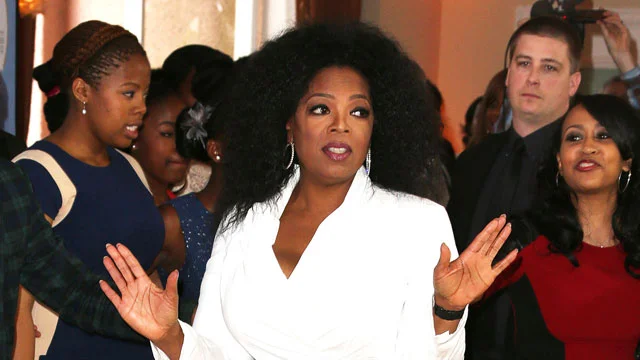
Oprah Winfrey’s engagement with racial discrimination has never been rooted in denial, silence, or convenience. Instead, she has consistently confronted racism as a lived reality while resisting the temptation to reduce human identity solely to race. Emerging from a society shaped by deep racial hierarchies, Oprah understood early that discrimination was both personal and systemic. Yet her response was neither bitterness nor exclusion, but a determination to expose injustice while affirming the dignity of all people. This balance became a defining feature of her moral and cultural leadership.
Growing up as a Black girl in the segregated American South, Oprah experienced racism not as an abstract concept but as an everyday limitation on opportunity and worth. These early encounters shaped her sensitivity to inequality and sharpened her awareness of how race intersects with class, gender, and power. Rather than allowing these experiences to harden her worldview, she transformed them into a lens of empathy—one that allowed her to speak honestly about discrimination while remaining open to shared humanity across racial lines.
In her media career, Oprah refused to ignore racism, but she also refused to sensationalize it. She created space for difficult conversations about race, privilege, and prejudice, often bringing together people with deeply opposing perspectives. Instead of fostering confrontation for spectacle, she emphasized listening, reflection, and accountability. This approach distinguished her from polarized media models, positioning dialogue as a tool for understanding rather than division.
One of Oprah’s most significant contributions was her insistence that racism is learned, not inherent. By highlighting stories of transformation and self-examination, she challenged the idea that prejudice is fixed or inevitable. Her interviews often revealed how ignorance, fear, and inherited narratives shape discriminatory attitudes, while also demonstrating that growth and unlearning are possible. In doing so, she affirmed the moral agency of individuals without excusing harmful behavior.
Oprah also confronted racism by broadening representation. She made deliberate efforts to ensure that people of all races, cultures, and backgrounds were visible within her programming—not as tokens, but as full human beings. This inclusive approach challenged the notion that empathy should be reserved for one’s own group. By humanizing difference, she helped audiences recognize common emotional truths that transcend race.
At the same time, Oprah remained clear that inclusion does not require the erasure of history or injustice. She consistently emphasized that healing begins with truth. Whether discussing slavery, segregation, or contemporary discrimination, she resisted narratives that minimized the pain of marginalized communities. Yet she framed these discussions within a forward-looking vision—one that sought reconciliation through acknowledgment rather than denial.
Oprah’s handling of backlash further illustrates her commitment to shared humanity. At various points in her career, she faced criticism from both Black and non-Black audiences—accused by some of being too race-conscious, and by others of not being confrontational enough. Rather than shifting her values to appease critics, she remained anchored in principle, demonstrating that ethical leadership often requires standing alone between extremes.
Her philanthropic work also reflects this philosophy. While she has invested heavily in Black communities, particularly in education, her humanitarian efforts have never been racially exclusive. Disaster relief, health initiatives, and global education projects supported by Oprah have crossed racial, national, and cultural boundaries. This pattern reinforces her belief that justice for one group does not require indifference to others.
Spiritually, Oprah’s emphasis on universal dignity has shaped her approach to race. She frequently speaks of a shared source of humanity—whether framed as God, Spirit, or collective conscience. This perspective does not ignore difference but places it within a larger moral framework where compassion, respect, and responsibility apply to all people. Her spirituality thus functions as a bridge between acknowledgment of racial realities and commitment to human unity.
In a media environment increasingly defined by tribalism and outrage, Oprah’s model offers an alternative path. She demonstrated that confronting discrimination does not require dehumanizing others, and that moral clarity can coexist with empathy. Her approach suggests that lasting social change is built not only through protest and policy, but through sustained efforts to reshape how people see one another.
Oprah Winfrey’s response to racial discrimination affirms a powerful truth: justice and humanity are not opposing forces. Confronting racism honestly while insisting on the shared worth of all people, she expanded the moral imagination of media and public discourse. Her legacy in this regard challenges future leaders to resist both silence and hatred, choosing instead a path that seeks truth, dignity, and collective healing beyond race.
Author: Moses A. Katamani
Email: infomoskambel@gmail.com
Website: www.kambelconsult.com