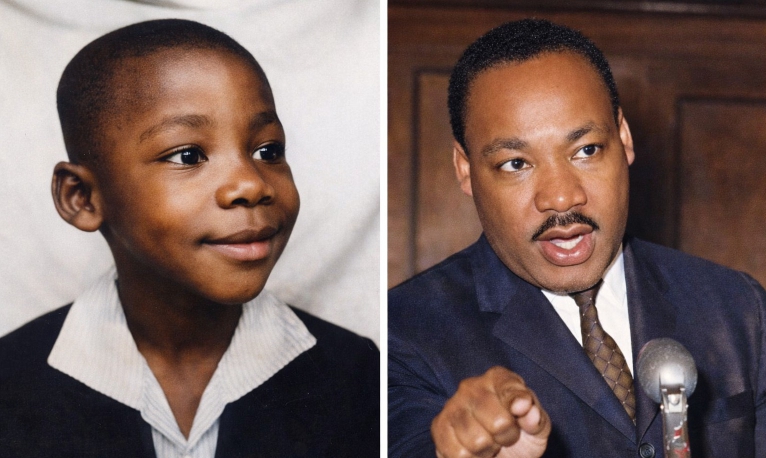
Martin Luther King Jr. did not appear one morning on the steps of the Lincoln Memorial as a fully formed prophet of justice, delivering a speech that would echo across the world. His greatness was not instantaneous; it was cultivated patiently, deliberately, and profoundly over decades, shaped by the intimate interplay of history, faith, and family. The dream that would one day ignite the hearts of millions was not born in a single oration but was nurtured through years of moral instruction, spiritual discipline, and lived experience in a society fractured by race and inequality. To grasp the depth of King’s leadership, one must first trace the origins of his formation, for it is within the fertile soil of his early life that the roots of his enduring dream were planted.
History reminds us that great movements are seldom spontaneous. They are the outward flowering of long, often invisible processes of preparation, cultivated in the hidden corners of thought, character, and conscience. In King’s case, the civil rights movement emerged as the public expression of a private moral journey that began in the tender and formative years of childhood. His early life unfolded against the stark realities of early 20th-century Black America; a world simultaneously marked by the cruelty of segregation, systemic discrimination, and daily suffering, yet also illuminated by resilience, communal solidarity, and profound spiritual strength. It was within this tension, between oppression and hope that the seeds of his dream began to germinate and quietly grow.
Martin Luther King Jr. was born on January 15, 1929, in Atlanta, Georgia, at the height of the Jim Crow era. He entered a world rigidly partitioned by race, where laws and social conventions enforced a strict hierarchy that systematically excluded Black Americans from full participation in civic, social, and cultural life. Schools, public transportation, restaurants, and even houses of worship were segregated, each serving as a reminder of the limitations imposed by racial prejudice. The social landscape of the American South was meticulously structured to reinforce daily humiliation and remind Black people of their marginalized status. In such a context, the denial of basic human dignity was not sporadic; it was institutionalized and inescapable.
Atlanta, though home to a burgeoning Black middle class, remained deeply bound by the oppressive structures of white supremacy. Families like the Kings navigated a precarious existence, carefully negotiating where they could go, how they could speak, and which ambitions they could safely nurture. Even as a young boy, King became acutely aware of the inequities around him. He observed that opportunities, respect, and recognition were too often determined not by merit, character, or intelligence, but by the color of one’s skin. These early observations awakened in him a profound moral consciousness; a nascent understanding that would guide the trajectory of his life and work.
At the heart of King’s early formation was his family. His father, Rev. Martin Luther King Sr., was a principled and resolute Baptist minister who imbued his son with a sense of pride, responsibility, and moral courage. He rejected the insidious notion of racial inferiority and consistently modeled integrity through both word and deed. His mother, Alberta Williams King, was gentle yet commanding, intelligent and deeply musical, fostering in her children a love of learning, reflection, and emotional depth. Together, his parents provided both the ethical framework and the emotional scaffolding upon which King’s character would be built.
The King household was inseparable from the Black church, which served not merely as a place of worship but as a vibrant center of education, leadership, and resistance. Within this sacred space, Black dignity was nurtured, moral vision cultivated, and young Martin was introduced to the principles of social responsibility. Faith, in this context, was never abstract; it was tangible, demanding, and active. It called for more than ritual, it demanded courage, ethical action, and a steadfast commitment to justice.
For young Martin, religion became both sanctuary and moral compass. It offered solace amid the harsh realities of a racially divided society while simultaneously challenging him to speak truth, serve others, and confront injustice without succumbing to bitterness or despair. From his earliest years, he was learning that faith and ethical responsibility were inseparable, laying the foundation for the moral rigor that would later define his life.
King’s childhood was far from insulated from the cruelty of racism. Some of his earliest and most vivid memories involved white childhood friends who, after reaching school age, were forbidden by their parents to continue playing with him. These moments, though devoid of physical violence, carried a powerful and painful lesson: boundaries imposed by prejudice are arbitrary, unjust, and deeply injurious.
Such experiences instilled in King both moral confusion and reflective curiosity. Why should friendship, trust, or dignity be conditional on the color of one’s skin? Why should love and respect be rationed by prejudice? Rather than hardening him, these encounters refined his empathy and nurtured a disciplined emotional intelligence. He learned to respond to cruelty not with retaliation, but with measured understanding and moral contemplation. From an early age, injustice became his teacher, instilling a habit of asking not only what is, but what ought to be, laying the groundwork for a life devoted to social reform and moral inquiry.
Gifted beyond his years, King entered Morehouse College at the extraordinary age of fifteen. There, he discovered a universe of ideas that expanded both his intellect and moral imagination. Morehouse was not merely an academic institution; it was a crucible for Black leadership, a place where young minds were trained to confront injustice with intelligence, courage, and ethical conviction.
A pivotal figure in his development was Dr. Benjamin E. Mays, president of Morehouse College, whose rigorous scholarship and unwavering ethical stance left an indelible impression on King. Mays taught him that faith without action was incomplete, and that intellectual insight must always be paired with moral responsibility. Through philosophy, theology, and ethics, King began to articulate a sophisticated understanding of social justice and the obligations of leadership.
Education at Morehouse refined King’s natural gifts, giving structure to his intuition, discipline to his thoughts, and eloquence to his convictions. Here, he began to see the possibility of harmonizing intellect, faith, and social action into a coherent framework for public life.
Despite his religious upbringing, King initially wrestled with the idea of entering the ministry. He understood the immense demands it entailed and was wary of superficial religiosity. Over time, however, he recognized that ministry was not merely a profession but a sacred vocation, a channel through which moral leadership could be exercised with authenticity and enduring impact.
This decision marked a profound turning point in his life. King embraced the principle that leadership is not about personal power, prestige, or gain; it is about service, responsibility, and guiding others toward justice. Ministry became the arena in which his intellectual and spiritual formation converged, equipping him to confront the moral crises that would define his era.
King’s early theological studies immersed him in Christian ethics centered on love, sacrifice, and the pursuit of justice. He encountered ideas that emphasized moral authority as a force capable of challenging political power without violence. Although his later adoption of Gandhian nonviolence would deepen and refine this principle, the seeds were already planted: King began to understand that disciplined love and ethical courage could confront oppression with transformative power.
He came to embrace the conviction that love is not weakness but strength; that true confrontation need not reproduce cruelty; and that justice could be pursued through patient, principled restraint. These beliefs would eventually form the cornerstone of his philosophy and public leadership.
Behind the confident orator and steadfast leader stood a young man quietly grappling with self-doubt, moral questions, and the weight of ethical responsibility. King balanced remarkable academic achievement with internal reflection, constantly refining both intellect and character. Patience, courage, empathy, and moral clarity were not innate qualities; they were forged through disciplined study, introspection, and sustained observation of human suffering. Long before the world knew his name, King was quietly developing the resilience, focus, and ethical fortitude that would equip him to lead a nation toward moral awakening.
By the time Martin Luther King Jr. rose to national prominence, the seeds of his dream had been deeply rooted in family, faith, rigorous education, and early encounters with injustice. His leadership was not improvised; it had been meticulously prepared over years of reflection, mentorship, and moral cultivation.
The dream that would inspire millions was first nurtured in quiet moments of childhood prayer, in spirited intellectual debates at Morehouse, and in the growing awareness that justice and love are inseparable principles. These formative experiences set the stage for the next chapter of his journey, in which theological insight, historical consciousness, and ethical courage would converge to awaken a movement destined to change the world.
Author: Moses A. Katamani
Email: infomoskambel@gmail.com
Website: www.kambelconsult.com