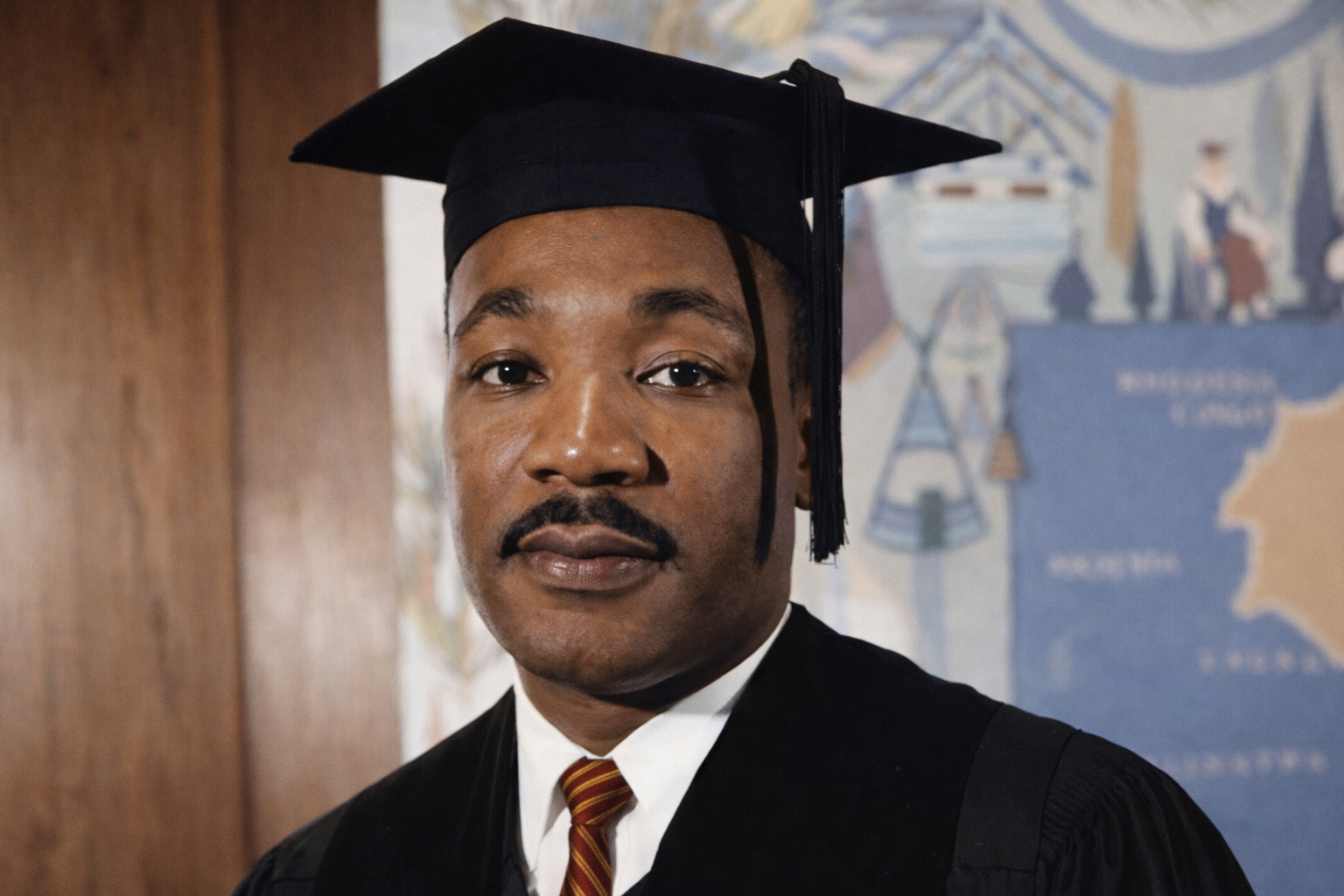
Before Martin Luther King Jr. emerged as a public leader capable of moving crowds and unsettling power, he was first a quiet, disciplined student, formed in the solitude of reading, reflection, and rigorous thought. His awakening did not occur only in churches or protest lines; it unfolded slowly in classrooms, libraries, and private moments of questioning. What stirred within him was not merely a moral sensitivity, but an intellectual realization: that ideas, when refined by ethical discipline and anchored in faith, could become instruments strong enough to confront even the most deeply rooted systems of injustice. Education became the bridge that connected the values he inherited from home to the purpose that would later define his life.
King’s academic journey began earlier than most and progressed with remarkable speed. At just fifteen years old, he entered Morehouse College, stepping into an environment that demanded seriousness of thought and maturity of character. Morehouse was not simply a place to earn credentials; it was a crucible for Black leadership at a time when opportunity was sharply restricted. The institution carried an unspoken charge that education must serve something larger than individual ambition. Within its walls, King encountered a philosophy of learning that framed knowledge as preparation for responsibility, and success as a means to uplift others rather than elevate oneself alone.
At Morehouse, intellectual achievement was inseparable from moral accountability. The college cultivated a culture that challenged students to measure brilliance not only by grades, but by character and contribution. Young scholars were encouraged to see themselves as future stewards of their communities, entrusted with the task of shaping a more just society. Immersed in this atmosphere, King began to shift his thinking away from personal advancement toward collective responsibility. These years quietly nurtured his awareness that leadership was not a privilege to claim, but a duty to accept.
One of the most decisive influences during this formative period was Dr. Benjamin E. Mays, the president of Morehouse College. Mays represented a rare synthesis of intellectual rigor and moral fearlessness. He demonstrated, through both scholarship and example, that faith and reason were not opposing forces but complementary ones. His sermons and lectures challenged students to confront social injustice directly, refusing the comfort of neutrality. For King, Mays became a living model of what principled leadership could look like; thoughtful, courageous, and unwilling to separate belief from action. This mentorship would leave a permanent imprint on King’s understanding of moral responsibility.
As King’s studies deepened, his intellectual horizons widened through sustained engagement with philosophy and social ethics. He encountered thinkers who wrestled seriously with questions of justice, freedom, human dignity, and moral obligation. These ideas sharpened his analytical instincts, teaching him to examine the structures beneath social suffering rather than respond only to its symptoms. Education gave him more than information; it provided him with conceptual tools: language, logic, and ethical frameworks that would later allow him to articulate injustice with clarity, depth, and persuasive force.
After Morehouse, King continued his formal preparation at Crozer Theological Seminary, where his thinking encountered even greater complexity. There, he was exposed to a wide range of theological perspectives and encouraged to engage in critical inquiry. Seminary life challenged him to move beyond inherited belief and toward a faith that could withstand scrutiny and doubt. Wrestling with difficult questions refined his spirituality, transforming it from tradition into conviction. His theology matured into one increasingly grounded in ethics, responsibility, and social relevance.
At Crozer, King quickly distinguished himself not only as an exceptional student but as a respected leader among his peers. He participated actively in debates about the role of the church in modern society, questioning whether religion should simply console the suffering or boldly confront the systems that produced suffering in the first place. These discussions sharpened his emerging belief that silence in the face of injustice was a moral failure. Faith, he concluded, lost its authority when it refused to engage the realities of oppression.
King’s intellectual journey reached a new level at Boston University, where he pursued doctoral studies in systematic theology. Immersed in advanced philosophical traditions, he refined his understanding of human dignity, freedom, and moral agency. His studies pushed him to think globally and historically, situating individual suffering within broader social and political frameworks. Through scholarship, King came to believe more deeply that ethical principles must guide not only personal behavior but the structures and institutions that govern society.
It was during these years of sustained study that King began to weave intellect, theology, and lived experience into a unified worldview. Education, he realized, was not an escape from struggle, nor a retreat into abstraction. Instead, it was a means of equipping the mind for engagement with reality. Thought, when disciplined and ethically grounded, could become a force for liberation, capable of naming injustice, inspiring action, and guiding resistance without surrendering moral integrity.
This period of intellectual awakening clarified King’s sense of calling with increasing urgency. The classroom had not prepared him for isolation within academia, but for confrontation with society’s deepest moral failures. Education sharpened his voice, theology anchored his conscience, and reflection transformed belief into direction. What lay ahead was no longer vague or uncertain. His path was coming into focus, shaped by both reason and responsibility.
By the time Martin Luther King Jr. stepped from lecture halls into the arena of public leadership, his mind had already been trained for the weight of history. His education shaped more than his intellect, it fortified his courage and disciplined his vision. The gifted student had become a thinker prepared to challenge injustice with clarity, faith, and unwavering moral resolve. The classroom had become a calling, and that calling was preparing to awaken a movement that would reshape a nation.
Author: Moses A. Katamani
Email: infomoskambel@gmail.com
Website: www.kambelconsult.com