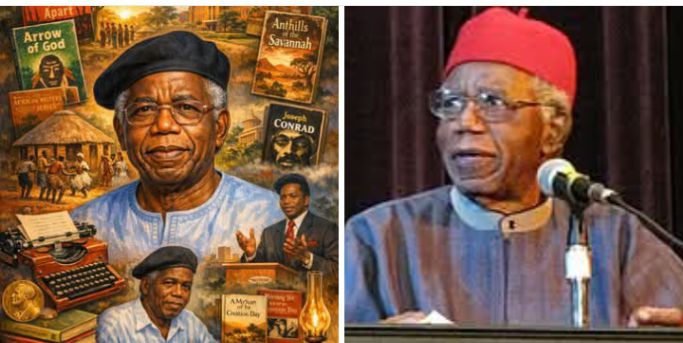
Chinua Achebe’s literary contributions rise like a pillar at the center of modern African literature, firm, enduring, and unmistakable. Through an expansive body of work that includes novels, short stories, essays, poetry, and cultural criticism, Achebe reshaped how Africa speaks to the world and how the world listens to Africa. His writing was never an exercise in art for art’s sake; it was an act of recovery and repair. With measured clarity and moral purpose, Achebe wrote to correct distortions, restore dignity, and reassert African humanity in a literary space long dominated by colonial imagination. His greatest achievement lies in transforming African experience into a universal literary language without surrendering its cultural soul.
Achebe’s most iconic work, “Things Fall Apart” (1958), stands as a watershed in world literature. The novel did not simply introduce African fiction to global audiences; it fundamentally altered the literary map. Set in pre-colonial Igbo society and unfolding during the first encounters with European colonialism, the novel reconstructs African life with patience, empathy, and narrative authority. Through the tragic arc of Okonkwo, a man both shaped and undone by his culture; Achebe explores masculinity, honor, tradition, and the violent disruptions of change. Proverbs pulse through the prose, folktales echo beneath the narrative, and communal values shape the moral universe of the story. In weaving oral tradition into written English, Achebe created a new literary idiom, African in spirit, global in reach. The novel’s translation into over fifty languages and its presence in classrooms worldwide testify to its timeless power and enduring relevance.
With “No Longer at Ease” (1960), Achebe extended his narrative vision into the psychological terrain of colonial modernity. Following Obi Okonkwo, the Western-educated grandson of Okonkwo, the novel examines the quiet corrosion of ideals under bureaucratic pressure. Obi’s tragic struggle against corruption, social expectation, and moral compromise reflects the broader dilemmas of a generation caught between tradition and imposed modern systems. Achebe shifts the setting from the village to the colonial city, exposing how education and opportunity do not automatically confer moral freedom. The novel is restrained yet piercing, revealing how colonial structures entangle even the well-intentioned in cycles of ethical failure.
In “Arrow of God” (1964), Achebe returned to the pre-colonial world with a narrative of profound philosophical depth. Centered on Ezeulu, the chief priest of Ulu, the novel probes the nature of authority, faith, and rigidity in times of transition. Ezeulu’s devotion to ritual law, admirable yet unyielding, places him in conflict with colonial administrators and his own people. Achebe presents colonialism not as a blunt force alone, but as a system that exploits fractures within indigenous societies. The novel’s moral complexity resists easy judgments, portraying tragedy as the outcome of both external pressure and internal inflexibility. For many critics, Arrow of God represents Achebe at the height of his artistic precision and intellectual maturity.
Achebe’s “A Man of the People” (1966) marked a striking tonal shift, embracing satire as a weapon of political critique. Set in a newly independent African nation, the novel dissects the rot beneath nationalist rhetoric. Through sharp humor and irony, Achebe exposes greed, hypocrisy, and moral collapse among postcolonial leaders who have replaced colonial masters but inherited their abuses. The narrator’s complicity in the corruption he condemns underscores the collective responsibility of society. The novel’s eerie prescience published shortly before Nigeria’s first military coup, cemented Achebe’s reputation as a writer with prophetic insight. Here, literature becomes an early warning system, alerting society to dangers ignored at its peril.
After the trauma of the Nigerian Civil War, Achebe returned to the novel form with “Anthills of the Savannah” (1987), a work marked by reflective depth and narrative experimentation. Set in a fictional African state ruled by military dictatorship, the novel employs multiple voices to examine power, resistance, and moral failure. Achebe broadens his vision, shifting away from heroic individualism toward collective responsibility. Female characters emerge as crucial moral agents, signaling Achebe’s evolving understanding of gender and leadership. The novel wrestles with despair yet refuses cynicism, affirming storytelling itself as an act of survival. Anthills of the Savannah stands as Achebe’s most politically intricate novel, a meditation on governance, conscience, and hope amid repression.
Beyond the novel, Achebe’s short stories, particularly those collected in Girls at War and Other Stories (1972), reveal his mastery of compressed narrative. These stories move across colonial encounters, wartime trauma, and personal disillusionment, capturing moments of human vulnerability and ethical choice. With economy and restraint, Achebe distills large historical forces into intimate human experiences. His short fiction demonstrates that brevity need not diminish moral weight; instead, it sharpens it.
Achebe’s influence deepened further through his work as an essayist and cultural critic. In Morning Yet on Creation Day (1975), he articulated a philosophy of African literature grounded in responsibility, relevance, and cultural truth. Later collections such as Hopes and Impediments (1988) and Home and Exile (2000) expanded his critique of Western literary dominance and interrogated questions of language, audience, and power. His uncompromising essay on Heart of Darkness, which challenged its racist underpinnings, sparked global debate and affirmed the legitimacy of African critical authority. Achebe’s essays are as enduring as his fiction, serving as intellectual roadmaps for African literary self-definition.
Although poetry occupied a quieter place in his oeuvre, Achebe’s collections, including “Beware, Soul Brother” (1971), offer a poignant counterpoint to his prose. Shaped by the anguish of the Biafran War, his poetry is restrained, meditative, and morally urgent. It reflects grief, loss, and the fragility of human institutions, speaking in a voice stripped of ornament yet heavy with meaning. Through poetry, Achebe explored sorrow and ethical responsibility with intimate vulnerability.
Achebe’s major achievements extend far beyond his written texts. He is widely regarded as the father of modern African literature in English, not because he was the first to write, but because he created a tradition others could inherit and expand. As an editor of the African Writers Series, Achebe helped launch the careers of countless African writers, ensuring that African stories reached African and global audiences alike. He was a teacher, mentor, and cultural custodian, committed to nurturing voices beyond his own.
His global recognition was affirmed through numerous honors, including the “Man Booker International Prize” (2007), the Nigerian National Merit Award, and multiple honorary doctorates. Though the Nobel Prize eluded him, Achebe’s stature transcends awards. His moral authority, intellectual courage, and cultural impact have rendered him a permanent figure in world literature. He did not merely seek recognition; he reshaped the standards by which recognition is given.
In sum, Chinua Achebe’s literary contributions form a monumental and living legacy. Through fiction, criticism, poetry, and cultural leadership, he transformed African literature into a space of dignity, complexity, and moral seriousness. His works continue to teach, provoke, and inspire, reminding readers that storytelling is not neutral, it is an act of memory, resistance, and vision. Achebe ensured that Africa would no longer be spoken for, but would speak for itself, with clarity, depth, and enduring power.
Author: Moses A. Katamani
Email: infomoskambel@gmail.com
Website: www.kambelconsult.com