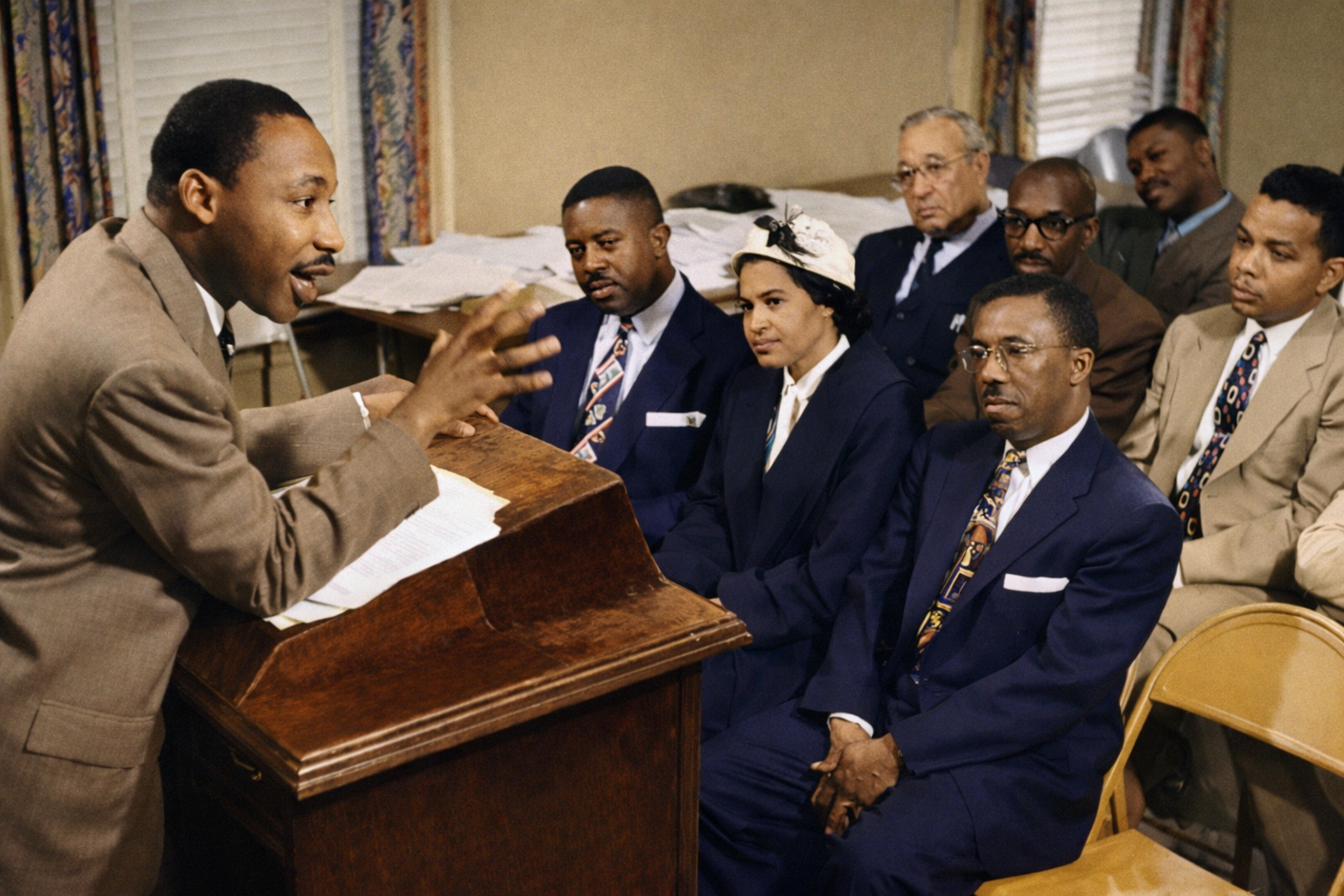
History does not always change through dramatic declarations or sweeping government reforms. Sometimes it shifts quietly, carried forward by ordinary men and women who grow weary of indignity and decide, collectively, that enough is enough. In Montgomery, Alabama, in 1955, such a moment arrived. What seemed like a routine act, boarding a city bus had long been layered with humiliation for Black citizens. Yet within that daily routine laid the seeds of transformation. When resistance finally took root, it reshaped not only a city’s transportation system, but the moral landscape of the United States. This turning point would also elevate a young pastor named Martin Luther King Jr. into national leadership and mark the true beginning of the modern Civil Rights Movement.
The segregated bus system in Montgomery stood as a visible and daily reminder of the racial caste system enforced throughout the South. City ordinances required Black passengers to sit at the back of the bus, even though they made up the majority of riders. If the “white section” filled up, Black passengers were legally required to surrender their seats, even if they had paid the same fare. Drivers often treated Black riders with open hostility, ordering them to board through the back door after paying at the front, sometimes driving away before they could re-enter. The buses became rolling symbols of disrespect and inequality. For years, complaints were made, frustrations expressed, and small acts of resistance attempted. But systemic change had not yet come. Beneath the surface, however, a readiness for organized protest was steadily building.
That long-awaited catalyst arrived on the evening of December 1, 1955. Rosa Parks, a respected seamstress and NAACP member, boarded a Montgomery bus after a day’s work. When the white section filled and the driver demanded that she and three other Black passengers surrender their seats, Parks quietly refused. Her defiance was calm, dignified, and deliberate. She was arrested and charged with violating segregation laws. While others had resisted before her, Parks’ arrest struck a powerful chord. She was known in the community as responsible and principled, making it difficult for critics to dismiss her stand. Her single act of refusal became a collective awakening. It signaled that the time for organized, sustained resistance had arrived.
Local leaders acted swiftly. The Women’s Political Council, led by Jo Ann Robinson, had long discussed the possibility of a bus boycott. Within hours of Parks’ arrest, thousands of leaflets were distributed across Montgomery’s Black neighborhoods, calling for a one-day boycott on December 5, the day of her trial. Churches spread the message from pulpits. Word traveled through barbershops, schools, and homes. When Monday morning arrived, the streets of Montgomery revealed something extraordinary: buses rolled through largely empty. Black residents, domestic workers, students, laborers, and professionals chose to walk instead. Some traveled miles on foot. Others shared rides in taxis charging reduced fares. The one-day protest was a resounding success, demonstrating the community’s unity and economic power.
Recognizing the need for continued organization, community leaders formed the Montgomery Improvement Association (MIA) to guide the protest. At its head, they elected Martin Luther King Jr., the young pastor of Dexter Avenue Baptist Church. Only twenty-six years old and new to Montgomery, King was seen as a unifying figure without longstanding rivalries. Though relatively unknown outside his congregation, he possessed eloquence, intellectual depth, and spiritual conviction. That evening, at a mass meeting at Holt Street Baptist Church, King delivered a speech that would define the movement’s tone. He declared that the protest was rooted not in bitterness, but in a love for justice. In that moment, the philosophy he had studied; nonviolent resistance grounded in Christian ethics, moved from theory into lived experience.
King’s leadership throughout the boycott emphasized discipline and moral clarity. He consistently urged participants not to retaliate, even in the face of hostility. Nonviolence was not weakness, he insisted, but strength under control. Mass meetings became spiritual revivals of purpose. Hymns echoed through packed sanctuaries. Testimonies of perseverance inspired renewed commitment. King reminded the community that their struggle was not against white individuals, but against unjust systems and laws. By framing the boycott as a moral issue rather than a political feud, he elevated the movement’s purpose and widened its appeal.
What began as a one-day protest extended into a 381-day campaign of remarkable endurance. The Black community of Montgomery built an intricate carpool system involving hundreds of vehicles and volunteer drivers. Churches functioned as dispatch centers, organizing routes and schedules. Families adjusted daily routines to accommodate long walks. Elderly women famously declared that their “feet were tired, but their souls were rested.” Economic pressure mounted as the bus company suffered significant financial losses. Yet the resolve of the boycotters did not weaken. Their shared sacrifice fostered deep solidarity and revealed the power of collective action grounded in faith.
Resistance from segregationists was swift and often violent. King and other leaders received threatening phone calls daily. In January 1956, King’s home was bombed while his wife, Coretta, and their infant daughter were inside. Miraculously, they were unharmed. An angry crowd gathered, some prepared to retaliate. But King stepped onto his damaged porch and urged calm, insisting that violence would betray their cause. Soon after, he and nearly ninety other leaders were arrested under an old anti-boycott law. Intimidation tactics, job threats, and legal harassment intensified. Yet each act of aggression only exposed the moral bankruptcy of segregation. National media coverage increased, and the eyes of the country and the world turned toward Montgomery.
Meanwhile, a parallel legal battle moved through the courts. In the case of Browder v. Gayle, attorneys challenged the constitutionality of bus segregation. In June 1956, a federal district court ruled that segregation on public buses violated the Fourteenth Amendment. The case was appealed, but in November 1956, the United States Supreme Court affirmed the lower court’s decision. Segregated buses were declared unconstitutional. On December 21, 1956, after 381 days, Martin Luther King Jr. and other Black leaders rode integrated buses in Montgomery. The boycott ended not in celebration alone, but in dignified resolution, a hard-earned victory achieved through disciplined persistence.
The Montgomery Bus Boycott accomplished far more than desegregating public transportation. It proved that organized, nonviolent mass protest could successfully challenge entrenched systems of injustice. It propelled King onto the national stage, leading to the formation of the Southern Christian Leadership Conference (SCLC), which would coordinate future campaigns across the South. Montgomery became a model for subsequent movements in Birmingham, Selma, and beyond. The boycott forged not only a victory, but a blueprint.
Ultimately, Montgomery’s turning point was about reclaiming human dignity. It was about a community discovering its collective strength. It was about faith translated into action and philosophy tested by fire. The boycott did not end racial injustice in America, but it ignited a sustained movement that would reshape laws, consciences, and history itself.
This reminds us that transformation often begins with a simple refusal to stand when told to sit, to comply when told to submit, to ride when walking becomes an act of resistance. From the streets of Montgomery rose a movement defined by disciplined love, moral courage, and unshakable hope. In walking together, the people of Montgomery helped a nation begin its long journey toward justice.
Author: Moses A. Katamani
Email: infomoskambel@gmail.com
Website: www.kambelconsult.com