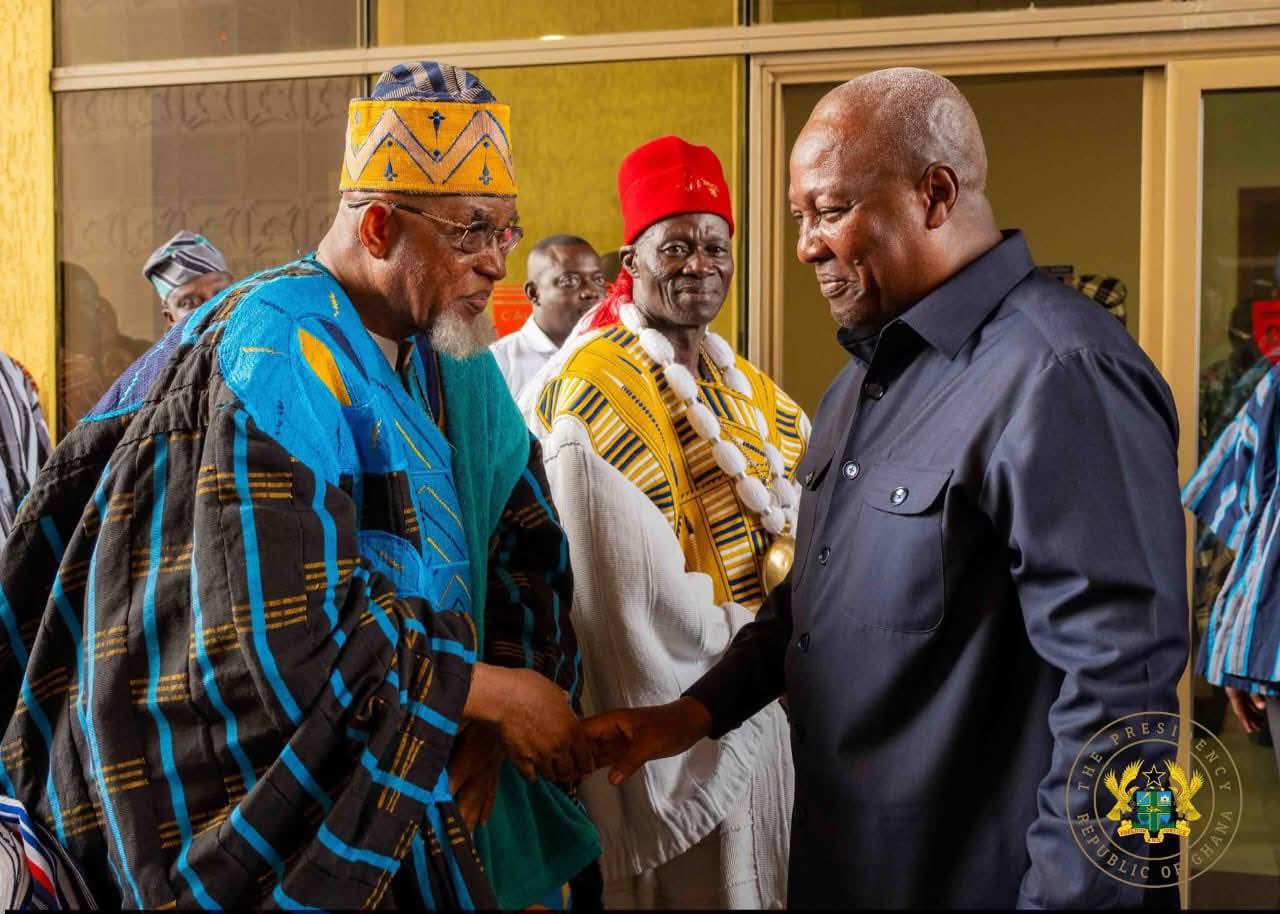
President John Dramani Mahama’s reaffirmation of his government’s commitment to collaborating with traditional authorities in the Upper East Region highlights a strategic recognition of the enduring influence of chieftaincy in Ghana’s governance structure. His engagement with the Upper East Regional House of Chiefs signals more than a ceremonial courtesy; it reflects a deliberate effort to anchor development initiatives within the framework of traditional leadership, which remains central to cohesion and grassroots mobilization in Ghana.
In Ghana’s Fourth Republic, traditional authorities occupy a constitutionally recognized but politically neutral space. While they do not participate directly in partisan politics, their moral authority and social legitimacy make them indispensable partners in maintaining peace and facilitating development. By emphasizing collaboration with chiefs, President Mahama appears to be reinforcing a governance model that blends modern state institutions with customary leadership structures.
The President’s praise for the House of Chiefs’ role in conflict resolution is particularly significant in a region that has, at times, experienced chieftaincy and land-related disputes. Stability in such areas cannot rely solely on security interventions; it requires mediation, dialogue, and culturally grounded leadership. By acknowledging the chiefs’ efforts in promoting social cohesion, Mahama is recognizing that sustainable peace is often negotiated within traditional systems before it is enforced by the state.
Beyond peacebuilding, the meeting also served as a platform to address longstanding developmental concerns in the Upper East Region. Historically regarded as one of Ghana’s less industrialized regions, the Upper East has grappled with infrastructure deficits that limit economic growth and investment attraction. Mahama’s announcement of plans to bridge these gaps suggests an attempt to reposition the region within the broader national development agenda.
The proposed construction of an airport in Bolgatanga stands out as one of the most ambitious commitments. If realized, the project could significantly enhance connectivity, facilitate trade, and stimulate tourism and investment in the northern corridor. Airports often symbolize economic integration, linking previously marginalized regions to national and international markets. However, such projects also demand careful feasibility assessment to ensure long-term sustainability and economic viability.
Mahama’s disclosure that a government delegation had inspected the earmarked land and confirmed its suitability demonstrates an effort to communicate preparedness and seriousness. By indicating that funding would come from the Airport Infrastructure Development Levy, the President provided a financing framework, which may help address concerns about resource allocation and fiscal prudence. His assurance that he would soon cut sod for the commencement of the project further signals political will to translate promise into action.
Infrastructure development, however, extends beyond aviation. The President’s broader pledge to improve road networks is equally critical. In many parts of the Upper East Region, poor road connectivity has hindered agricultural distribution, cross-border trade, and access to essential services. Enhancing road infrastructure would not only complement the airport initiative but also address immediate mobility challenges faced by residents.
The response from the Upper East Regional House of Chiefs reveals a reciprocal dynamic in this partnership. Their appreciation for Mahama’s engagement underscores the importance traditional authorities place on direct dialogue with the executive branch. At the same time, their appeals for the revamping of the Pwalugu Tomato Factory, completion of the Navrongo Youth Resource Centre, and construction of an ultramodern sports stadium in Bolgatanga highlight specific areas where development promises have yet to be fully realized.
The call to revive the Pwalugu Tomato Factory reflects broader concerns about agro-industrialization and job creation in the region. Such factories are not merely production centers; they are potential anchors of local economic ecosystems, supporting farmers, traders, and transport operators. Similarly, completing youth-centered infrastructure like the Navrongo Youth Resource Centre and investing in sports facilities could address unemployment and social engagement challenges among young people.
This engagement between the presidency and traditional authorities underscores a broader governance lesson: development is most effective when it is participatory. Chiefs, as custodians of land and culture, play a vital role in facilitating land acquisition, mobilizing community support, and ensuring that projects align with local priorities. Their involvement can accelerate implementation and reduce resistance that often accompanies top-down development planning.
In sum, the visit to the Upper East Regional House of Chiefs illustrates the interconnected nature of peace, partnership, and progress. By reaffirming collaboration with traditional authorities while outlining tangible infrastructure commitments, President Mahama is positioning development as a shared national endeavor. The true test, however, will lie in implementation, whether the promises of airports, factories, roads, and youth facilities materialize into measurable improvements in the lives of the people of the Upper East Region.
Author: Moses A. Katamani
Email: infomoskambel@gmail.com
Website: www.kambelconsult.com