The arrest of Wendell Nana Yaw Yeboah, a member of the Democracy Hub movement, has stirred a fresh national conversation about free speech, misinformation, and the limits of state authority. What began as a petition submitted to the Criminal Investigations Department (CID) by representatives of the Ashanti, Eastern, and Western Regional Ministers has now evolved into a wider public debate. The incident raises questions not only about legal procedure, but about how Ghana should confront the growing challenge of false information circulating in the political space.
According to the Police, Yeboah was arrested after a formal request for a full investigation into alleged false claims he made concerning illegal small-scale mining activities. A police statement indicated that he had been taken into custody and was scheduled to be put before court, with assurances that the investigation would be conducted in accordance with the law. While the Police presented the development as a standard legal response to a petition, the involvement of three regional ministers as complainants naturally heightened public scrutiny.
The sensitivity surrounding the matter stems largely from the political weight of the individuals involved. High-ranking government officials filing complaints in a case concerning public commentary can easily be interpreted as a demonstration of political influence, even if the legal process is technically triggered through normal channels. This dynamic has fueled debate about how the state exercises its authority in matters that touch on public discourse.
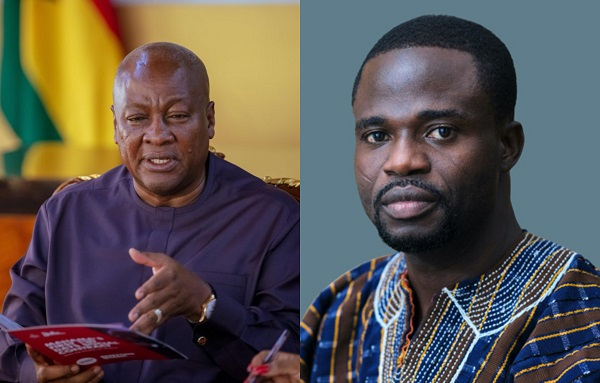
Investigative journalist Manasseh Azure Awuni responded strongly to the development, arguing that the arrest represents a concerning pattern under President John Dramani Mahama’s administration. In a Facebook post, Azure maintained that individuals who believe they have been defamed possess the right to seek civil redress in court rather than resort to police action. For him, the practice of initiating criminal processes in such cases risks sliding into the terrain of suppressing dissenting voices.
Azure also questioned the justification for detaining suspects “to assist investigation,” noting that individuals are often kept in custody even before their cases are fully assessed. He asked why a person would need to be held behind bars and prepared for court appearances if the purpose of the process was merely investigative cooperation. In his view, this contradicts the constitutional spirit of tolerance and free expression associated with President Mahama.
Furthermore, Azure called on the Attorney-General to take immediate steps to repeal what he considers an overly broad and easily misapplied law on publishing false news. He drew parallels to the now-repealed Criminal Libel Law, which was abolished under former President J.A. Kufuor to strengthen Ghana’s democratic culture. Azure argued that the present law is being used in ways similar to the past, raising fears about a regression in civil liberties.
His concerns reflect legitimate apprehension about the potential for state overreach, particularly where political actors are directly involved. Ghana’s democratic evolution has long required vigilance against tendencies that could constrain open debate or instill fear among critics. Historical examples show that laws intended to regulate public communication can easily be turned into tools for political control, whether by design or by misinterpretation.
However, Azure’s commentary brings to light another dimension of the issue, one that he notably does not emphasize: the consequences of falsehood on people’s public life. Misinformation has the power to damage reputations, mislead the public, and heighten political tensions. In a country where illegal mining is already a highly charged issue affecting national resources and community livelihoods, false claims can exacerbate disputes and weaken public trust for institutions.
This raises an important question our Ghanaian society: How should the nation balance the protection of free speech with the responsibility to curb harmful misinformation? It is not enough to defend civil liberties without acknowledging the real impact falsehood can have on governance and social cohesion. Addressing this dual challenge requires more than criticism of government actions, it calls for a thoughtful framework that ensures accountability on all fronts.
Potential alternatives to criminal arrests exist, including civil litigation, improved digital literacy campaigns, clearer regulatory guidelines, and the strengthening of fact-checking platforms. These tools offer avenues for addressing misinformation while minimizing the risk of political influence on law enforcement. They reinforce the idea that protecting freedom of expression and maintaining truth in public discourse are not mutually exclusive goals.
Journalists, given their influence in shaping national conversations, have a crucial role in this balancing act. Their narratives help frame public understanding of events, state decisions, and civic responsibilities. Thus, any critique of state action should also engage with the broader question of how society can discourage the deliberate spread of misinformation. Responsible journalism requires an honest assessment of both rights and responsibilities.
In sum, the arrest of Yeboah has opened an important national dialogue. It provides an opportunity not only to scrutinize the role of the state, but also to reflect on the shared responsibility of citizens, public officials, activists, and the media in safeguarding both freedom and truth. As Ghana continues to strengthen its democratic institutions, finding a fair and coherent approach to managing false information will remain a central challenge, one that demands clarity, balance, and consistency.
New Analysis: Moses A. Katamani
Email: kambelconsult@gmail.com
Website: www.kambelconsult.com