Oprah Winfrey’s commitment to education stands as one of the most powerful pillars of her humanitarian legacy. For Oprah, education has never been a symbolic gesture or a public relations tool; it is a deeply personal mission shaped by lived experience. Growing up, she encountered education as her first doorway to hope and self-belief. Books, classrooms, and mentors became spaces of refuge where her imagination and confidence were nurtured. From an early age, she learned that education was not merely about certificates, but about liberation, the power to imagine a different future and acquire the tools to reach it.
In the United States, Oprah consistently used her influence, wealth, and voice to support educational advancement, particularly for underprivileged children and youth. She understood that talent is universal, but opportunity is not. Through scholarships, grants, and targeted interventions, she helped remove financial barriers that prevented capable students from pursuing their dreams. Her initiatives focused not only on academic success but also on restoring dignity and self-worth to students who had been marginalized by poverty and inequality.
Through the Oprah Winfrey Foundation and related initiatives, she provided direct financial assistance to students seeking higher education. These efforts ensured that promising young people were not forced to abandon their aspirations because of economic hardship. Oprah often emphasized that investing in one student could transform an entire family’s future, creating a ripple effect that extended far beyond the individual beneficiary. Her philanthropy reflected a long-term vision rather than short-term charity.
One of Oprah’s most notable contributions to education in America was her unwavering support for literacy and public education. She recognized reading as the cornerstone of learning and personal development. By promoting books through her television platforms and book clubs, she ignited a national culture of reading. Millions of viewers were introduced to literature that expanded their understanding of history, identity, and human experience, making reading both accessible and aspirational.
Oprah’s dedication to education also extended to mentoring and leadership development. She invested in programs designed to nurture young leaders, especially those from disadvantaged backgrounds who lacked access to role models and networks. By emphasizing confidence, discipline, ethical values, and purpose, she reinforced the idea that education should shape character as much as intellect. Her vision of learning was holistic, preparing students not only for careers but for meaningful lives.
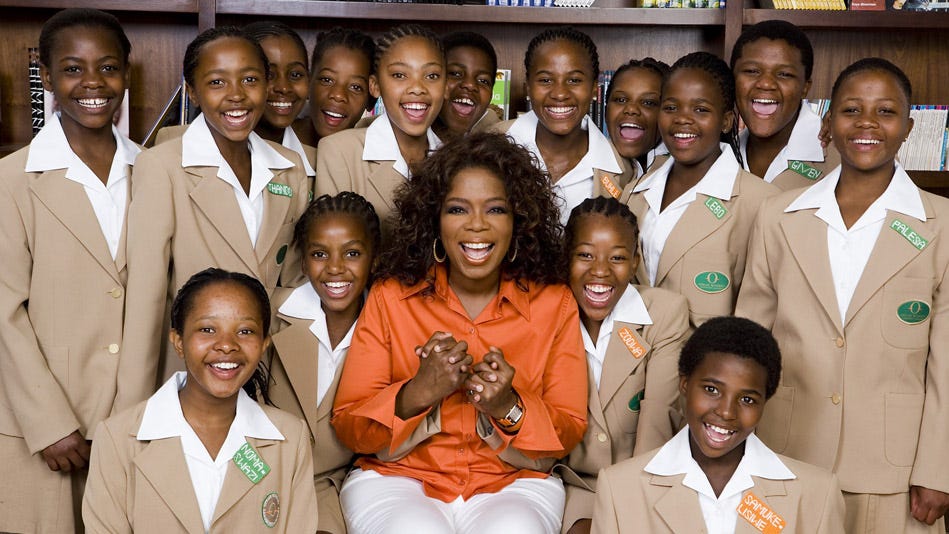
In Africa, Oprah’s educational legacy is most symbolized by the Oprah Winfrey Leadership Academy for Girls in South Africa. Founded in 2007, the academy was created to provide world-class education to academically gifted girls from impoverished backgrounds. Oprah personally oversaw the vision of the school, ensuring it offered not only academic excellence but also emotional care, mentorship, and leadership training. For her, the school was an investment in future African leaders.
The Leadership Academy reflects Oprah’s deep belief in the transformative power of educating girls. She recognized that when girls are educated, the benefits extend to families, communities, and nations. By equipping young women with education and leadership skills, the academy challenges entrenched cycles of poverty and gender inequality. Its graduates stand as living proof that opportunity, when combined with discipline and support, can produce extraordinary outcomes.
Beyond South Africa, Oprah supported broader educational initiatives across the African continent. Her philanthropic efforts included scholarships, community school support, and partnerships with organizations working in regions affected by poverty, conflict, and disease. These initiatives demonstrated her understanding that education must reach children in the most vulnerable conditions if meaningful global progress is to be achieved.
Oprah’s approach to education in both America and Africa emphasized dignity, sustainability, and long-term impact. Rather than offering temporary solutions, she focused on building institutions, strengthening systems, and empowering individuals to become self-sustaining agents of change. Her investments were intentional, aiming to create environments where learning could thrive for generations.
Another defining feature of Oprah’s educational philosophy is her emphasis on values-based leadership. She consistently advocated for education that nurtures integrity, empathy, resilience, and service to others. In her view, academic excellence without moral grounding is incomplete. This belief shaped the institutions and programs she supported, ensuring that students were prepared not only to succeed professionally but also to lead responsibly.
Oprah’s influence also helped draw global attention to educational inequality. By speaking openly about her initiatives and the challenges facing underserved communities, she inspired other philanthropists, corporations, and governments to prioritize education. Her advocacy elevated global conversations about access, equity, and quality, reinforcing education as a shared responsibility rather than a privilege for the few.
In the end, Oprah Winfrey’s support for education in America and Africa reflects a profound belief in human potential. She has shown that when individuals are given access to knowledge, mentorship, and opportunity, they can rise beyond circumstance and transform their societies. Her educational legacy is measured not only in schools built or scholarships awarded, but in lives reshaped, confidence restored, and futures reimagined, ensuring her impact will endure for generations to come.
Author: Moses A. Katamani
Email: infomoskambel@gmail.com
Website: www.kambelconsult.com